
7 Signs a Tree Needs to Be Removed from Your Property
If you have noticed something off about a tree on your property, you are probably trying to figure out whether it is worth worrying about. A lean that looks worse than it used to. Branches that did not leaf out this spring. Something growing at the base that was not there last year.
Most homeowners are not arborists. Telling the difference between a tree that needs to come down and one that just looks rough takes some knowledge, and the stakes are real. A tree that fails unexpectedly can damage a roof, a fence, a car, or worse. Oak Park and the surrounding Cook and DuPage County area is full of mature trees, which means this is a question homeowners here face more often than most.
Not every concerning sign means removal. But some signs are serious enough that waiting to act increases the risk significantly. If you have been dealing with broader tree health issues on your property, 5 Common Tree Problems Homeowners Face in Oak Park, IL covers the range of conditions that can affect trees in this area.
This blog covers the seven signs that most reliably indicate a tree needs to be removed, and what to do when you spot them on your property.
1. A Significant or Sudden Lean
A slight lean is not automatically a problem. Trees grow toward light, and most develop a natural lean over time that is stable and not cause for concern.
The lean that warrants attention is one of two things: a lean that is dramatic enough to compromise the tree’s architecture, or one that has developed recently without a clear explanation. A sudden lean is a structural red flag. It often points to root failure or internal decay at the base, either of which can cause the tree to come down without much warning.
The direction of the lean matters too. Consider where the tree is pointing:
- Toward the house, a garage, or another structure
- Toward a neighbor’s property or fence line
- Toward a power line or utility infrastructure
- Into open space with nothing underneath
The first three are higher-priority situations than the last. A tree leaning into open space is still worth monitoring. A tree leaning toward your roof is a different conversation.
After a storm is the most common time homeowners notice a new lean. Wind events can shift root anchorage in ways that are not visible from the surface. If a tree looks different after a significant storm, that is worth getting eyes on quickly.
2. Large Dead Branches in the Upper Canopy
A single dead branch on an otherwise healthy tree is not a removal situation. Trees shed branches for a range of reasons, and isolated deadwood is often addressed through professional tree trimming rather than removal.
The sign that points toward removal is different. It is about volume and location. Multiple large dead branches concentrated in the upper canopy suggest something systemic is happening. Disease, root stress, and advanced structural decline all tend to show up from the top down first. By the time the upper canopy is visibly failing, the problem has usually been developing for some time.
Dead branches in the upper canopy are also a direct falling hazard. In the Chicago area, where wind events are common and winter ice loading adds weight to already weakened branches, dead wood in the upper canopy comes down. It does not need to look obviously dead to fail in a storm. Brittle wood snaps under load that healthy branches would handle without issue.
3. Fungal Growth at the Base or on the Trunk
Mushrooms or shelf fungi growing at the base of a tree or directly on the trunk are not a landscaping nuisance. They are an indicator of internal wood decay.
The important thing to understand about fungal growth is the timing. Fungi break down wood from the inside out. By the time growth appears on the exterior of the tree, significant structural damage has often already occurred inside. The exterior can look fine. The interior can be compromised in ways that are not visible until something fails.
This sign is easy to overlook precisely because the tree above the fungal growth can look completely healthy. Full canopy, green leaves, no visible damage to the bark higher up. None of that changes what is happening at the base.
Not every instance of fungal growth means the tree needs to come down immediately. But it always warrants a professional evaluation. A tree with internal decay at the trunk base is structurally unpredictable, and the only way to assess how far the decay has progressed is to have someone who knows what to look for take a close look.
4. A Hollow or Compromised Trunk
The trunk is what holds the tree up. When the interior of the trunk deteriorates through decay, the tree becomes increasingly vulnerable to wind, ice load, and its own weight. A hollow trunk is not a cosmetic issue. It is a structural one.
Hollowness is not always visible from the outside. One way homeowners can check on their own is to tap the trunk firmly with a hard object and listen for the difference between a solid thud and a hollow ring. It is a basic test, but it can surface something worth following up on.
Beyond sound, look for these physical indicators:
- Vertical cracks running along the trunk
- Large sections of missing or peeling bark
- Visible cavities or open wounds in the trunk
- Areas where the bark surface looks sunken or collapsed inward
A tree does not need to be completely hollow to be a removal candidate. The threshold is whether enough sound wood remains to support the tree safely under normal conditions, including wind and weather load. That assessment requires a professional. What looks like a small cavity from the outside can connect to a much larger area of internal decay.
5. Root Damage or Disruption
Root damage is one of the most dangerous signs on this list precisely because it is the hardest to see. A tree with significant root damage can look completely healthy above ground while the structural foundation is already failing below. By the time surface symptoms become visible, the risk is often already serious.
Surface indicators that point to root problems include:
- Soil heaving or lifting on one side of the tree, which can indicate roots pulling away from the ground
- Dead or thinning patches in the lawn that radiate outward from the trunk in a pattern
- Recent construction, utility work, or grade changes that affected the area within the tree’s root zone
- Exposed roots that show physical damage, cuts, or decay
In older Oak Park neighborhoods, root disturbance is a realistic concern for mature trees. Utility lines run through established root systems. Sidewalk and driveway repairs cut through roots that have been growing for decades. Construction activity on adjacent properties changes drainage and compacts soil in ways that stress root systems over time.
A tree that loses a significant portion of its root system may look healthy for a full season or two before above-ground decline becomes visible. The structural failure risk, however, does not wait for the symptoms to catch up.
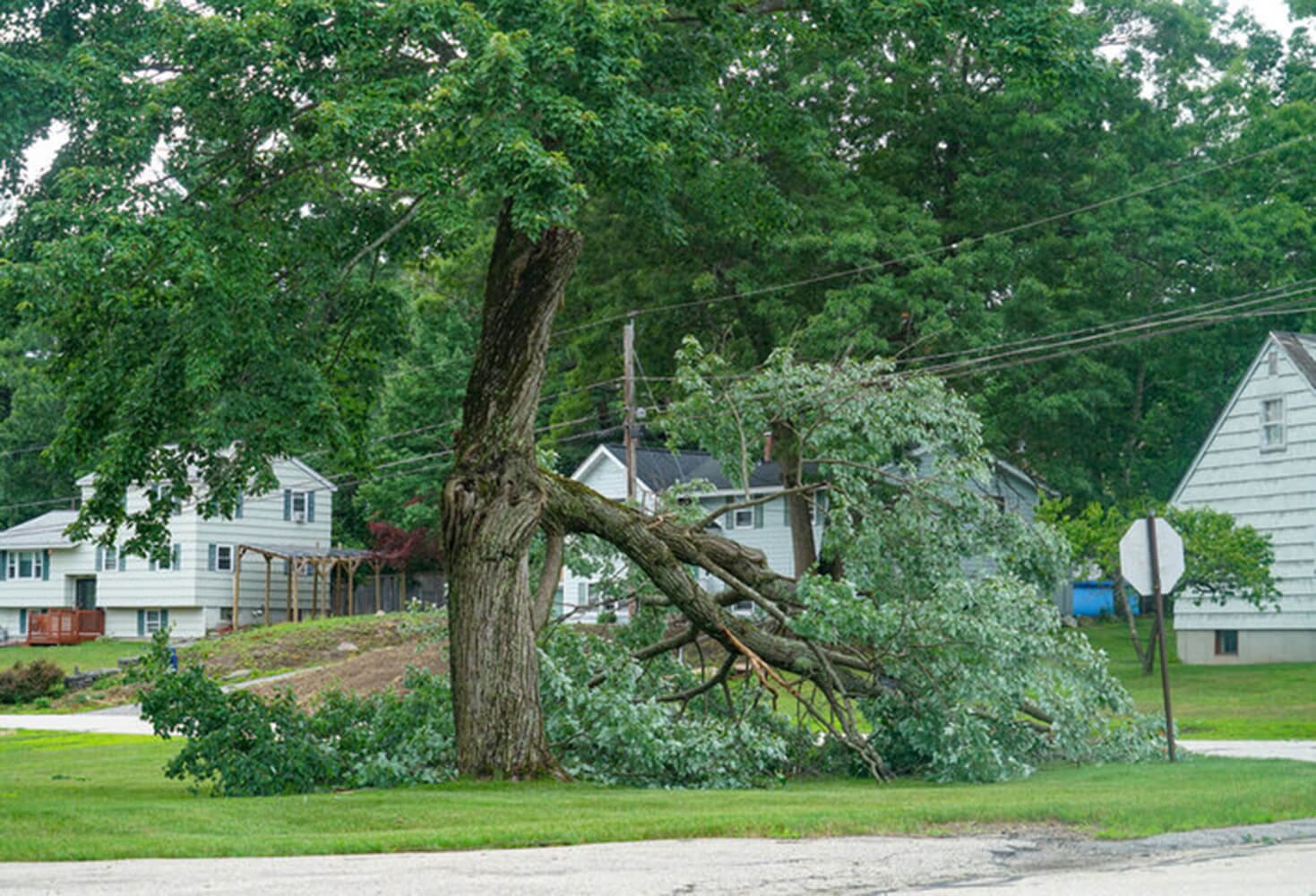
6. Trunk Damage from a Storm or Wound
Storm damage does not automatically mean a tree needs to come down. Trees can absorb significant damage and recover, depending on what was affected and how much of the tree remains structurally sound.
The situation becomes a removal conversation when the damage crosses certain thresholds:
- The tree has lost more than roughly a third of its canopy in a single storm event. A tree that loses that much of its leaf and branch mass is unlikely to recover the structural integrity it had before.
- The trunk itself has split or cracked at a major attachment point. A split trunk is not a repairable condition.
- Large open wounds on the trunk are not healing over. Open wounds expose the interior of the tree to decay and insect entry, which accelerates decline in ways that may not be visible for months.
The right question after storm damage is not whether the tree looks bad. A damaged tree can look terrible and still be structurally sound. The question is whether the remaining structure is sound enough to hold the tree safely going forward. That requires an honest assessment of what is still holding the tree up, not just what fell off.
7. The Tree Is Dead
A dead tree has no path to recovery. It becomes more dangerous with every season it remains standing. Wood deteriorates, the root system loses its grip on the soil, and the tree becomes increasingly brittle and unpredictable.
Signs that a tree is dead rather than dormant or stressed:
- No leaf or bud development during the growing season
- Bark that sloughs off in large sections without green tissue underneath
- Branches that snap cleanly without bending
- A trunk that sounds hollow when tapped throughout, not just in one area
- Absence of any living tissue when a branch is lightly scratched
Dead trees in Oak Park are subject to village ordinances that may require removal within a specific timeframe, particularly when the tree is on a parkway or above a certain diameter. A crew familiar with local regulations can advise on timing and handle the permit process. Waiting on a dead tree does not reduce the obligation or the risk. It increases both.
A dead tree close to a structure or over a frequently used area should be a priority for removal, not a future project.
Schedule a Free Tree Evaluation in Oak Park
One of the most important things to understand about tree risk is the gap between what a homeowner can see and what a professional evaluates. Homeowners are working from visible symptoms on the surface. A qualified arborist is evaluating whether the tree’s internal structure, root system, and load distribution can still hold it safely. Those two pictures can look completely different.
A tree that appears stable can fail quickly once internal decay or root failure reaches a critical point. Waiting to see if things get worse is not a risk-free position. It is a decision to accept more exposure the longer it goes on.
If any of the signs in this blog look familiar, the right next step is a professional evaluation, not a wait-and-see approach. If you have already identified a problem tree and want to understand what the removal process involves, What to Expect When Having a Tree Removed in Oak Park, IL walks through the full process from estimate to cleanup.
We serve Oak Park and the surrounding area, handle the stump once the tree is down, and are happy to take a look at any tree you are concerned about. Contact us today to schedule a free on-site estimate.